The Difference Between Reaction & Response
 Kerbad Marolia
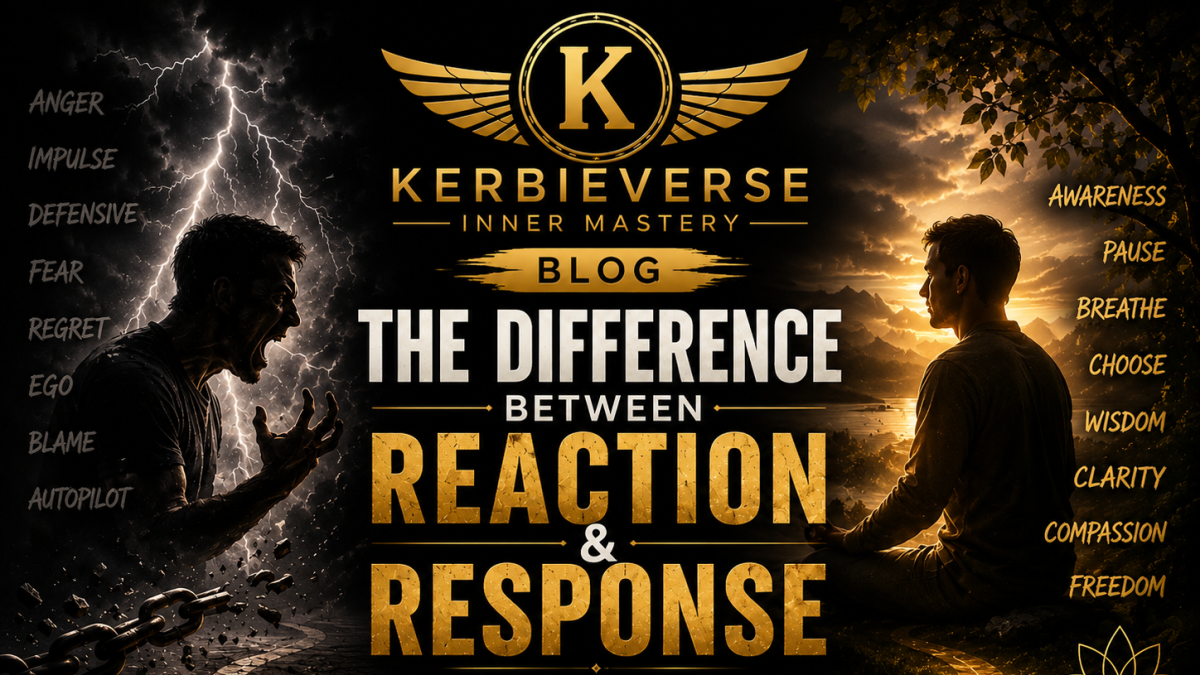
The Difference Between Reaction & Response
By KerbieVerse Inner Mastery
Life is unpredictable.
People will disappoint you.
Plans won’t always work out.
Unexpected situations will arise when you least expect them.
While you cannot control everything that happens around you, you can always learn to control how you respond.
This is one of the greatest lessons of Inner Mastery.
The difference between reacting and responding may only last a few seconds, but those few seconds have the power to change your relationships, your wellbeing and your entire direction in life.
What Is a Reaction?
A reaction is automatic.
It happens before we’ve had time to think.
It is often fuelled by emotion rather than wisdom.
Someone criticises you…
You become defensive.
Someone cuts you up in traffic…
You become angry.
Someone ignores your message…
Your mind immediately creates stories about why.
Reactions are usually driven by old conditioning, habits and unconscious patterns.
In many ways, reactions belong to the past.
They are familiar responses that we’ve repeated so many times they feel automatic.
What Is a Response?
A response is different.
A response begins with awareness.
Instead of allowing emotion to take control, you pause.
You breathe.
You observe what is happening both around you and within you.
Only then do you decide how you wish to act.
Responding doesn’t mean suppressing your emotions.
It means allowing wisdom to guide them.
The Space Between
There is a beautiful truth that many wise teachers have shared throughout history.
Between what happens and how you respond, there is a space.
Within that space lives your freedom.
Most people never notice it.
Everything happens so quickly that they believe their reactions are inevitable.
But with practice, that space becomes larger.
What once felt impossible suddenly becomes a choice.
You begin responding with patience where you once reacted with anger.
You choose compassion where you once chose judgement.
You remain calm where you once felt overwhelmed.
This is the quiet power of Inner Mastery.
Why We React
Our reactions often come from three places:
Fear.
Past experiences.
The ego’s desire to protect us.
Sometimes we react because something reminds us of an old wound.
Sometimes we react because we feel misunderstood.
Sometimes we simply react because we’ve never learned another way.
Understanding this doesn’t excuse harmful behaviour.
It creates compassion.
Both for ourselves and for others.
Responding Requires Practice
Nobody becomes calm overnight.
Responding is like strengthening a muscle.
The more you practise, the stronger it becomes.
Each time you pause before speaking…
Each time you choose curiosity instead of assumption…
Each time you take one conscious breath before replying…
You strengthen your ability to live intentionally.
Eventually, what once required effort begins to feel natural.
Choosing Peace
Many arguments are won but relationships are lost.
Many people prove themselves right while losing their peace.
Inner Mastery asks a different question.
Instead of asking,
“How do I win?”
Ask,
“What response reflects the person I want to become?”
Sometimes that response is speaking.
Sometimes it is listening.
Sometimes it is walking away.
Peace is not weakness.
It is wisdom expressed through self-control.
Final Thoughts
Every day offers countless opportunities to choose.
Reaction or response.
Fear or understanding.
Judgement or compassion.
Impulse or intention.
The world may never stop presenting challenges.
But as your awareness grows, you begin to realise something extraordinary.
You are no longer controlled by every situation.
You become the one choosing how to meet it.
That is freedom.
That is Inner Mastery.
🌟 Reflect
Think about a recent situation where you reacted emotionally.
If you could relive that moment today, how would you choose to respond differently?
🛠 Practise
Before responding to anything challenging today, remember three simple steps:
Pause.
Breathe.
Choose.
Even one conscious breath can change the outcome of a conversation.
✨ Inner Mastery Takeaway
“Your greatest power is not controlling what happens to you. It is choosing how you respond.”